



THE GRAYVAULT BRIEF — ISSUE 002
April 05, 2026
The Recalibration Window
America is flailing and its adversaries are moving strategically. This is what happens when the world's dominant military power commits fully to one theater.
On March 29, while the Iran war dominated every headline, Kim Jong Un personally oversaw a ground test of an upgraded ICBM engine; the most powerful North Korea has ever tested. 2,500 kilonewtons of thrust, up from 1,971 in September. He called it a significant development elevating his country's strategic military power to the highest level. Days earlier he had given a speech to parliament explicitly referencing the US war in the Middle East, calling American foreign policy state terrorism and aggression.
Kim's actions represent both an opportunistic display of nuclear power while western media is distracted by carnage in the middle east, and an act of deterrence against US aggression.
Deterrence, Not Just Capability
While the engine test is being reported as a program milestone, it also has other meaning.
North Korea watched the US launch a sustained air campaign against a sovereign nation, kill its supreme leader, and talk openly about regime change. From Pyongyang's perspective, US and Israeli actions represent a live demonstration of what happens to countries they decide to target.
Also, the solid-fuel element has significance of its own. Solid-fuel missiles are harder to detect before launch, unlike liquid-fuel systems that appear on satellite imagery while fueling up.
Pyongyang's message to Washington is clear: we are not Iran.
Kim's explicit naming of the Iran War during his recent parliamentary speech, followed shortly after by the engine test, is a deliberate sequence of events.
The Moves Nobody Is Watching
While it would be easy to get caught up in the engine test headline and stop there, it is important to zoom out to recognize patterns forming that would otherwise get more media coverage in a less distracted news environment.
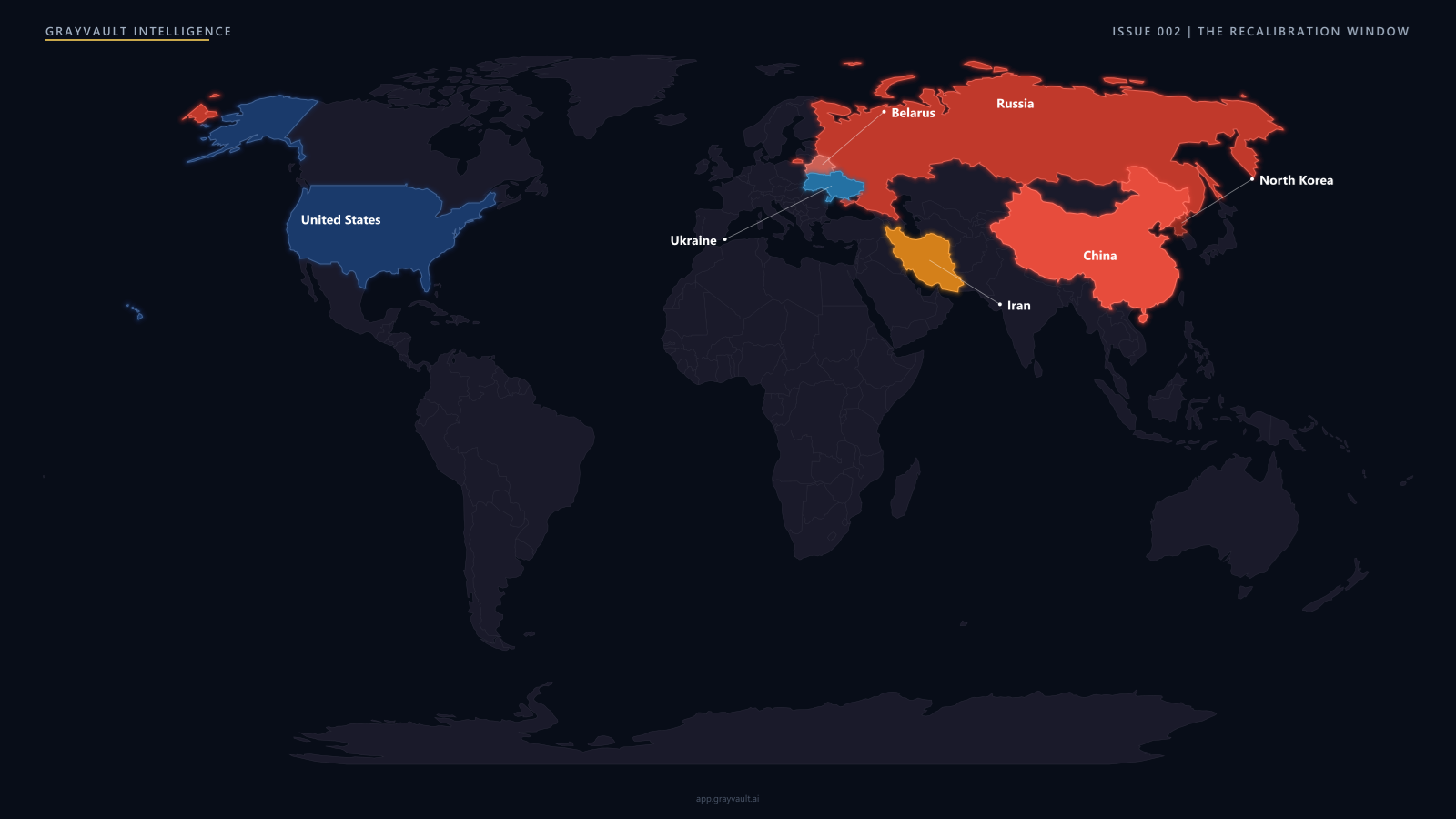
In March 2026, Belarus opened an embassy in Pyongyang, a Russia-NK friendship treaty was signed, and KCNA and TASS formalized a news exchange agreement.
Looking at all of these events as part of a strategic move by several actors is the correct way of perceiving them.
North Korea is diversifying its portfolio. China has, for decades, held the leverage in its bilateral relations with its Korean neighbour as its nearly exclusive trading partner and defensive security guarantor. However, that dynamic appears to be shifting. A friendship treaty with Russia signals Moscow sees value in closer NK ties. The KCNA-TASS agreement signals coordinated messaging, information sharing, narrative alignment. And an embassy in Belarus signals Belarus is willing to stake diplomatic capital on the relationship. And let's not forget that Belarus is a de facto vassal state of Russia. Pyongyang is continuing to cozy up to the Kremlin.
Individually, each of these moves are small, calculated, and timed. Together, they signal strategy. North Korea is positioning itself for a future where China isn't the only patron in the room, at a moment where the superpower that would otherwise contest these moves is consumed elsewhere.
None of this came from nowhere. Before the Iran war, North Korea had already deepened its relationship with Russia through troops and ammunition for Ukraine. Thousands of North Korean soldiers deployed to support Russian operations in exchange for military technology transfer, sanctions relief, and geopolitical backing. That relationship had already been building before March 2026. The embassy, the treaty, the TASS agreement are all the diplomatic formalization of something that was already happening on the battlefield.
The Broader Pattern
North Korea is far from the only actor reading this environment.
Russia is advancing in Ukraine while US attention is in the Gulf. China is watching American munitions stockpiles deplete at rates that take years to replenish. In the first 16 days of the Iran war the US burned through nearly half its ATACMS inventory. THAAD interceptors consumed at similar rates. Raytheon was producing roughly 60 Tomahawks a year before the war started.
However, Russia, China, and North Korea are not on the verge of decisive action. For each actor, internal cohesion, capability, and readiness are all real constraints. Russia is grinding through Ukraine with significant losses, China's People’s Liberation Army (PLA) is mid-purge, and North Korea's economy remains severely constrained. None of these actors can simply look at a distracted America and decide the moment has come.
What they can do, and what they are doing, is learn.
The Iran war is an open-source intelligence event of historic proportions. Every observer with analytical capability is watching how many Tomahawks the US expends, how quickly THAAD interceptors deplete, how air defense systems perform under sustained attack, how long a superpower can sustain an air campaign before the question of ground troops becomes unavoidable. China in particular is running its own after-action analysis in real time since a hypothetical future Taiwan scenario involves (among other aspects) an air war over a strait. Watching how the US conducts one through its targeting doctrine, munitions consumption rates, and domestic tolerance for sustained operations, is invaluable preparation for a theater Beijing has been planning for decades.
Every observer and state actor in geopolitics understands that if carrier groups are in the Gulf, they cannot also be in the Taiwan Strait. The air defense assets being consumed in the Middle East cannot simultaneously be positioned near Korea. The political bandwidth being spent on Tehran is not available for Taipei or Seoul.
Beijing, Moscow, and Pyongyang are each independently reading the same environment and drawing the same conclusion, Washington is aggressive and unpredictable, and also stretching itself very thin.
Xi said clearly he wants the PLA ready for a possible Taiwan contingency by 2027. The military purges of the last year, while appearing destabilizing on the surface, are more likely Xi cleaning house to ensure loyalty and readiness for future plans.
What To Watch
Three things matter in the next 60 days.
Does the Iran war grind or resolve? A quick end resets the deterrence picture fast. A stalemate extends the window and everything that comes with it.
Does North Korea follow the engine test with an actual ICBM launch? The previous engine series was described as final in September, then they built a more powerful one. A launch before the US-China summit would be a deliberate signal to Washington at a moment of maximum leverage.
How does Seoul respond? If South Korea starts hedging quietly, diplomatically, economically, toward Beijing or Moscow, that's the clearest sign that the deterrent credibility question is real and affecting behavior beyond just the adversaries.
The question is whether Washington is paying attention, or cares about its geostrategic interests at all.
Methodology note: Grayvault scores are based on hand-scored baselines calibrated against eight authoritative data sources. UN voting alignment figures are sourced from the Voeten UNGA dataset. Arms transfer figures are sourced from the SIPRI Arms Transfers database. Full methodology at app.grayvault.ai/methodology.
Craig Graham is the founder of Grayvault Intelligence. He studied political science, international relations, international security, and history, and previously worked as a junior Asia-Pacific security analyst at Canada's only government foreign policy office outside Ottawa.
Grayvault Intelligence tracks relationships between every country in real time at grayvault.ai