



THE GRAYVAULT BRIEF — ISSUE 001
March 27, 2026
The Number
10.
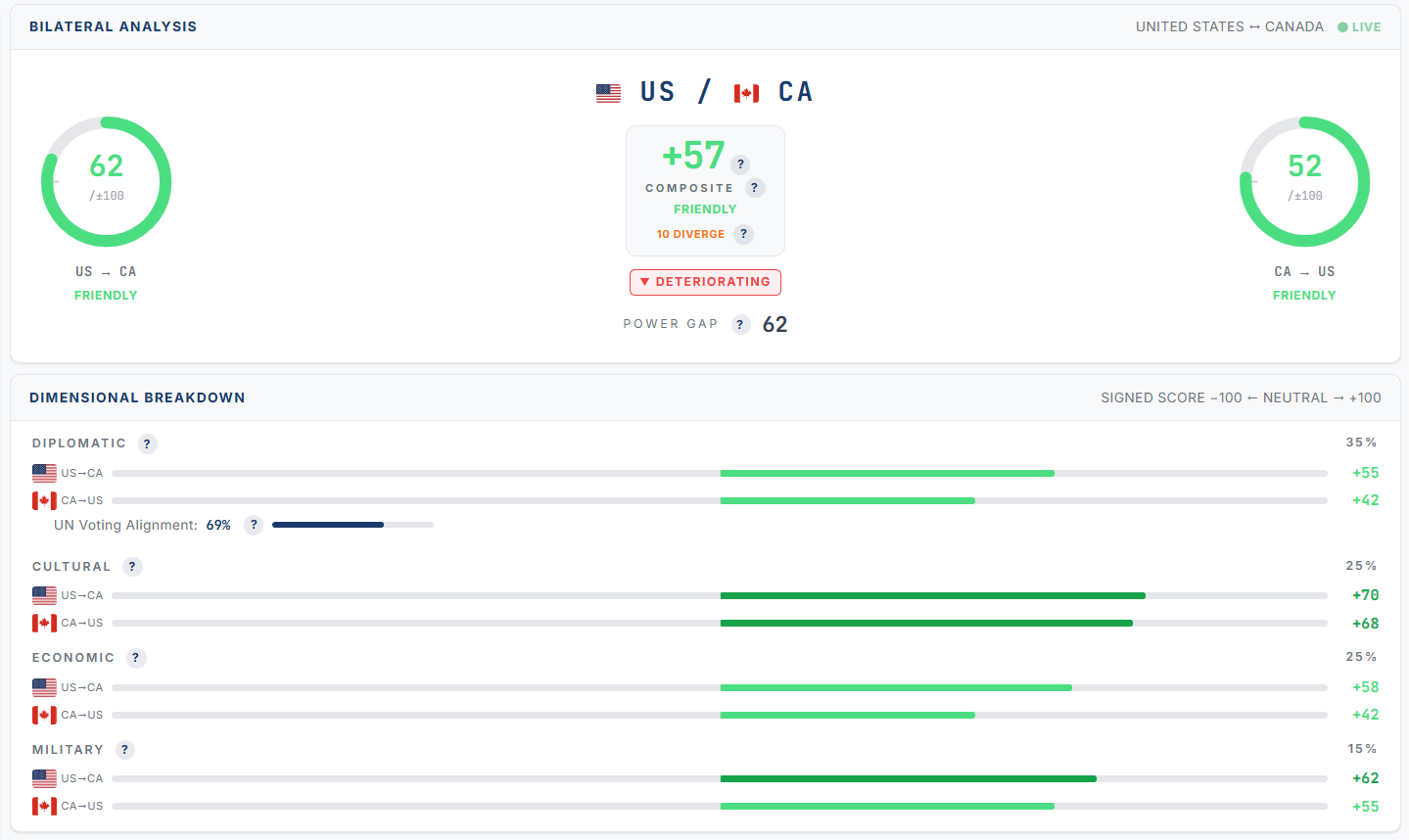
That is the divergence between how Canada views the United States and how the United States views Canada in Grayvault's bilateral scoring system.
Canada scores the relationship at +52. The United States scores it at +62. Both sit in the Friendly tier. Both show a deteriorating trajectory.
In a relationship built on nearly $1 trillion in annual goods trade, a shared defense perimeter, and 8,891 kilometers of undefended border, a 10-point divergence in how each country perceives the other is worth examining. It reflects something real: Canada feels this relationship more existentially than the United States does. And the data shows it.
What the Scores Mean
Grayvault scores bilateral relationships across four dimensions — Diplomatic, Cultural, Economic, and Military — weighted and calibrated against eight authoritative data sources. The CA-US pair currently shows:
- Canada's view of the US: +52 Friendly
- US view of Canada: +62 Friendly
- Trajectory: Deteriorating in both directions
- Sensitivity: HIGH — meaning single events can move this score significantly
- Escalation ceiling: Competitive — the relationship could deteriorate two full tiers from current levels under severe stress
The 10-point divergence is the largest asymmetry currently recorded between any two G7 allies in Grayvault's dataset. It captures something that aggregate bilateral assessments miss: the two sides of this relationship are not experiencing it the same way.
Why the Asymmetry Exists
From Ottawa's perspective the relationship has become existential in a way it has never been before. Trump's repeated suggestions that Canada become the 51st state, the partially imposed 25% tariffs on Canadian goods, the framing of bilateral trade as an American subsidy to a free-riding neighbor — this isn't normal alliance friction.. They represent a fundamental challenge to assumptions Canada has relied on since the 1940s.
From Washington's perspective Canada remains a reliable partner — a Five Eyes ally, a NORAD partner, the largest export market for American goods, supplying 62% of US crude oil imports. The institutional relationship is intact. The political relationship is a negotiating tactic.
That gap is what the 10-point divergence measures.
What the Structural Data Shows
Grayvault's economic dimension for CA-US draws on UN Comtrade bilateral trade data. The numbers are significant:
- Nearly $1 trillion in annual goods trade (Statistics Canada 2024)
- Canada is the top destination for US goods exports
- The US is the destination for 76% of Canadian goods exports
- Auto parts cross North American borders up to seven times before a car is finished
Neither country can easily restructure this. The economic integration is deeper than the political relationship — which is precisely what makes the current stress test analytically interesting. Most deteriorating Friendly relationships weaken structurally first. CA-US is deteriorating politically despite structural integration that has never been stronger.
On the military dimension: the US supplies 78% of Canada's arms imports (SIPRI Arms Transfers database). NORAD is a jointly operated binational aerospace defense command. Canada can't replace these.
On diplomatic alignment: Canada and the US vote together at the UN General Assembly 69% of the time (Voeten UNGA dataset) — high, but notably lower than other Five Eyes partners. The gap reflects longstanding Canadian independence on multilateral issues that predates Trump.
The Variable That Matters Most
The first mandatory joint review of CUSMA/USMCA is scheduled for July 1, 2026 — three months from now. What was designed as a routine six-year assessment has become the highest-stakes trade negotiation Canada has faced in a generation.
The Trump administration has signaled it will use the review to seek concessions beyond the agreement's original scope — on energy, digital services, dairy, and potentially non-trade issues including defense spending and border security. Canada's position, under Carney's government, is to defend the existing framework while seeking tariff relief.
The July review is the single variable most likely to move the CA-US score in either direction over the next six months. A renewal with modest adjustments stabilizes the score. A fundamental restructuring attempt — or a breakdown in negotiations — pushes it toward Neutral or worse.
Grayvault's HIGH sensitivity rating for this pair means the score can move quickly when conditions change. July 1 is the date to watch.
A Note on Interpretation
The +52 score for Canada's view of the United States may read as generous given the current political climate. It reflects an analytical judgment that the Trump administration's rhetoric toward Canada — while producing real economic consequences — is largely detached from US popular opinion, institutional reality, and the structural interests of both countries. The threats are real in their effects. The follow-through is unlikely to be permanent. What Grayvault's scoring captures is the current state of the structural relationship, which remains deeply integrated, alongside a trajectory signal that says clearly: this is moving in the wrong direction.
The risk is asymmetric. Canada cannot restructure its economy away from the United States in any meaningful timeframe. The US can absorb a deteriorating relationship with Canada far more easily than Canada can. That asymmetry — captured in the 10-point divergence — is the analytically significant story, not the absolute score level.
What the Data Doesn't Show
Grayvault's scoring reflects observable actions and structural data. It does not capture:
The psychological shift in Canadian public opinion — the surge in Canadian nationalism, the "buy Canadian" movement, the political realignment around economic sovereignty as an electoral force. These are real and will affect the relationship's trajectory but are harder to score from pipeline events alone.
The institutional resilience built over decades — NORAD, Five Eyes, integrated supply chains, shared legal systems, shared culture. These create enormous friction against rapid deterioration and are partly why the score remains solidly Friendly despite the political stress.
The relationship is under strain. The architecture is holding. The question for 2026 is whether the architecture is strong enough to outlast the strain.
View CA-US Bilateral Pair →View Canada Profile →View US Profile →
Methodology note: Grayvault scores are based on hand-scored baselines calibrated against eight authoritative data sources. UN voting alignment figures are sourced from the Voeten UNGA dataset. Arms transfer figures are sourced from the SIPRI Arms Transfers database. Full methodology at app.grayvault.ai/methodology.
Craig Graham is the founder of Grayvault Intelligence. He studied political science, international relations, international security, and history, and previously worked as a junior Asia-Pacific security analyst at Canada's only government foreign policy office outside Ottawa.
Grayvault Intelligence tracks relationships between every country in real time at grayvault.ai